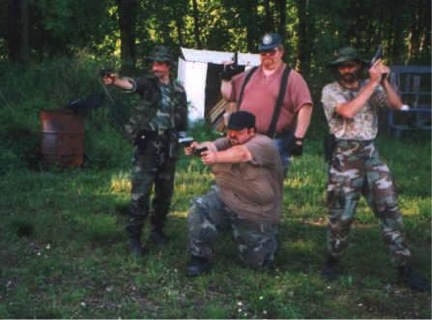
Let’s get this straight from the get-go. Poking around in the origins of the Second Amendment may be great fun but it’s moot. While entertaining, perhaps even illuminating, trying to decipher what James Madison said in this or that Federalist Paper, or what Anti-Federalist George Mason objected to, is as relevant as an evangelical claiming to be a small-c christian. Unlike evangelicals the Constitution evolves. See Amendments 11 through 27. Times change, the Constitution gets updated. Amendment 12 was a frank admission that the founders had made a total bollocks of that whole “how to elect the President” thing. When the 13th Amendment abolished slavery no one cared what Jefferson or Madison once thought about the subject. When the 19th granted women’s suffrage no one cared why George thought Martha shouldn’t vote. And, for the cherry on top, we have the 21st Amendment:
“The eighteenth article of amendment to the Constitution of the United States is hereby repealed.”
In other words, some prior amendment hasn’t panned out so we’ve eighty-sixed it. Let’s be clear about this. If today’s citizens think the Constitution is broke they have every right to fix it. Amen. Hallelujah. ‘Nuff said.
Now, if you’re still here, let’s poke around a bit.
The Standing Army Problem
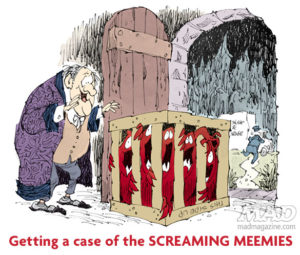
This whole gun issue stems from the fact that the very idea of a standing army gave the Founders a
terminal case of the screaming meemies.
England had a standing army and its king, that naughty boy, had sent it to Boston to coerce the citizens into submission. Something about taxation. So, when the time came for us to make a government, neither the Federalists, who favored ratification of the new proposed Constitution, nor the Anti-Federalists, those opposed, fancied the idea of a professional army. The Anti-Federalists didn’t want one at all:
- “a standing army …, one of the most hurtful, and most dangerous of abuses”.
- A standing army is “that great support of tyrants”.
- Standing armies “are dangerous to the liberties of a people”.
- “What havoc, desolation, and destruction, have been perpetrated by standing armies!”
While sharing these sentiments, the Federalists also saw the necessity. Here’s James Madison, the “Father of the Constitution”:
Lacking a standing army, “any powerful nation, prompted by ambition or avarice, will be invited, by our weakness, to attack us.”
And, “such an attack, by disciplined veterans, would certainly be attended with success, when only opposed by irregular, undisciplined militia.”
And so, in Federalist 46 we see:
“Let a regular army, fully equal to the resources of the country, be formed; and let it be entirely at the devotion of the federal government;”
But then the sly dog hedged his bet:
“still it would not be going too far to say, that the State governments, with the people on their side, would be able to repel the danger.”
In short, Madison wanted a national army but wanted it small enough it couldn’t defeat a combination of state militias. Notice he is not saying that every Tom, Dick and Harry gets a gun to oppose government oppression. He’s saying that federal encroachment on states should be opposed by state militias. We are, after all, talking about a federation of states, not a nation of one people.
Haggling between the two camps produced the Constitution’s Army and Militia Clauses. Here’s the relevant snippet of the Army Clause:
“The Congress shall have Power To … raise and support Armies…”
So the Federalists got their standing army but by design it was too small to deal unaided with invasion, and was certainly not to be used domestically.
Hence the Militia Clauses, the first being Clause 15:
“The Congress shall have Power To …provide for calling forth the Militia to execute the Laws of the Union, suppress Insurrections and repel Invasions”.
Three notes:
- It’s not the Executive Branch that calls out the militia, as in England, but the Legislative. This provides an added protection as a sufficient number of the members of Congress, supposedly per the will of their constituents, could put the kibosh on any project opposed by those constituents. You know, because elected representatives always do what their constituents want.
- Executing the law? Isn’t that law enforcement? As in police departments? Funny you should ask. Turns out there were no police departments. That leftist, socialist idea didn’t come about in America until 1838, and then just in Boston where they had a surplus of Irish guys.
- Suppress insurrections? Wait. Isn’t the Second Amendment supposed to be about resisting the government? More on this later…
While we’re still doing clauses, here’s Clause 16:
“The Congress shall have Power To …provide for organizing, arming, and disciplining, the Militia, and for governing such Part of them as may be employed in the Service of the United States, reserving to the States respectively, the Appointment of the Officers, and the Authority of training the Militia according to the discipline prescribed by Congress.”
Two things this time:
- The states appoint officers and handle training.
- The federal government arms the militia.
Birth of the Second Amendment
That second bit freaked the Anti-Federalists. Hold on a sec, they said, ’cause they were pretty hip dudes. Letting the federal
government arm and equip the state militias meant the federal government could neuter those militias by
simply neglecting them. So a compromise was struck:
“A well regulated militia being necessary to the security of a free state, the right of the people to keep and bear arms shall not be infringed.”
Two things:
- The people can keep and bear arms in case the federal government doesn’t arm the state militias.
- It is only because a militia is necessary that we’re even talking about anyone being armed. The founders used this formulation routinely. First they state the justification and then comes the resolution.
Say, Whatever Happened to That Militia?
Which raises the question, why were state militias necessary? What were the threats to the security of a free
state back then and are they still relevant?
- Foreign invasion. No longer relevant as we now do have standing military.
- Federal oppression by its standing army. No longer relevant as there is simply no way in hell any collection of citizens could possibly oppose the national military.
- Border trouble with Native Americans. No longer relevant thanks to genocide.
- Insurrection. No longer relevant as we now have the various law enforcement options – and the National Guard.
- Local Riots, civic unrest. No longer relevant as we now have the various law enforcement options – and the National Guard.
Hmm. If none of those threats are still relevant why do we still have a militia? We do have one, right? In fact, we do. Like the Constitution, however, it has evolved. To see how and why, return with us now to those thrilling days of yesteryear and examine how that whole militia notion worked out. And what to our wondering eyes should appear but that well known fact that the best laid plans gang oft agley? There were problems:
- Logistics. Any organized force needs standardized arms and equipment. Imagine trying to support a force in which Tom has a blunderbuss, Dick a squirrel gun and only Harry has an actual military grade musket. What happens when Tom’s blunderbuss blows a gasket? Who’s got a replacement? What happens when Dick runs out of ammo for his squirrel gun? Did the government stock up on that those pellets? A fella needed to be careful with those squirrel guns, by the way. You could put someone’s eye out. And that’s just the guns and ammo. How about all the rest of the equipment?
- Incompetent officers. Wouldn’t you know it? Left to their own devices governors appointed political favorites to command the troops rather than men who might actually be competent militarily. Those not appointed by higher-ups were elected by the troops. A militia get-together typically being nothing more than a beer bash, the troops tended to elect the guy with the most kegs.
- Poorly trained troops. Of course, if the officers are clueless how can you expect the troops to know what they’re doing? Those folks with bumper stickers claiming “These colors never run” are evidently unfamiliar with American military history. Take the Bladensburg races for example when our vaunted militia skedaddled in the face of British regulars and left the way open to sack and burn Washington, DC. In fact, the very word “skedaddle” comes from Union forces rushing pell mell from First Manassas.
- 90 day enlistments, most of which was spent training and transporting so that when combat finally came the enlistments were up and the militia bugged out, which happened repeatedly in the 1812 War and again in the Mexican War.
- Chain of command. In 1812 the governors of MA, CT, RI refused to allow their militias out of their states. Invasions of Canada flopped when OH, PA and NY militia balked at the border.
- Militia nullification. This was actually a thing, a la jury nullification. If the local militia, for whatever reason, didn’t feel being called out was justified, they simply stayed home. Many refused to muster during the Whiskey Rebellion, Fries Rebellion and numerous other disturbances.
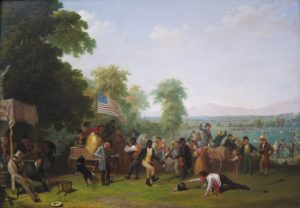
These issues led to different strategy in the Mexican, Civil and Spanish American Wars. Since the Army Clause gave
Congress the right to “raise and support armies” militia were eschewed and volunteers were used instead. Militia units would
volunteer en bloc, as with the famous Rough Riders. While that worked better it was clear further tweaking was needed.
Enter the Dick Act. I’ve always wanted to say that. Though it sounds like something today’s GOP would gleefully pass it isn’t. Its less catchy name is “The Efficiency in Militia Act of 1903”. The Dick Act and further militia acts in 1908, 1916, 1920 and 1933 established, among other things, two kinds of militia: the organized and the unorganized. The organized militia is basically the National Guard. The unorganized is every able-bodied male citizen between 17 and 45.
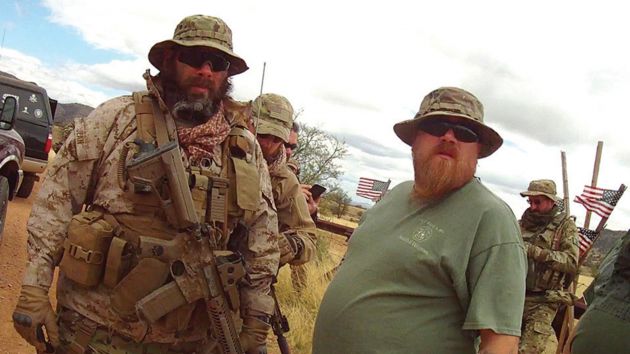
So, now who’s the well regulated militia that justifies the Second Amendment? Clearly not the National Guard since its members do not arm themselves, but are armed by the federal government. So, if there still exists a well-regulated militia that needs to arm itself, it can only be the unorganized one. And yes, that does sound like an oxymoron.
In fact, a guy could be forgiven for not realizing he was even in this militia. Most have no idea. What’s more, in case of national emergency what happens if the federal government calls up the unorganized miltitia? Bring your AK-47s, AR-15s, your shotguns, target pistols, whatever you have and let’s go kill some bad guys? No. Of course they would be equipped by the federal government. So, again, no need to bring your guns to town, son.
So, while a militia, namely the National Guard, is still necessary, there is no longer a militia that needs to arm itself, which removes the justification for the entire Amendment.The Constitutional Right to Rebel
But of course, that’s not the “argument”, is it? Second Amendment buffs choose to ignore the justification phrase of the Amendment (and what does that tell you about their devotion of originalism?) and instead postulate defense against a tyrannical government. This is known as the Constitutional right to revolt. Some folks say there is one, some not. Alrighty then. Let’s see how that argument has shaped up.
Shortly before the Constitutional Convention we have, in Massachusetts, the Shays Rebellion and, in New Hampshire, the Paper Riot or Exeter Rebellion. Shortly after ratification we have, in Pennsylvania, the Whiskey Rebellion and Fries Rebellion. Rebelling was all the rage in those days, usually about tax laws. After all, that’s how it all began. In each case we have a passel of ordinary folk snatching up their ordnance to register strenuous objection to perceived tyranny. Each time they laid claim to militiahood, calling themselves Regulators or comparing themselves to the famous Minutemen, prancing up and down to drum and fife. Each time the poopyhead government, be it state or federal, called up official militia to subdue the riff raff. In the Whiskey Rebellion George Washington became the only sitting president to lead troops in the field. In the Exeter Rebellion the leaders were only indicted for treason, in all the others they were convicted. In each case the culprits were pardoned unless they had also committed common law crimes. In each case the rebels claimed a constitutional right to rebel, in each case the rebelled-against government said, no way.
So it seems that any old group of males between the ages of 17 and 45, while officially being members of the unorganized militia, do not have a legal constitutional right to decide on their own to mobilize and take up arms, and if you do don’t be surprised if you’re convicted of treason.
Witty Conclusion
If you insist on getting all originalist about the Second Amendment, while of course ignoring the first half of it, you might at least be consistent enough to adhere to the subsequent resolution of the 1792 Congress clarifying which arms might be borne and provide yourself with “a good musket or firelock, a sufficient bayonet and belt, two spare flints, and … a quarter of a pound of powder”.
