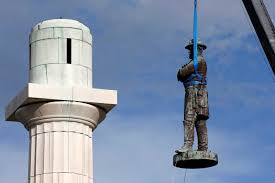
Monuments to Bobby Lee, Jeff Davis and Stonewall Jackson, the holy trinity of Stone Mountain, litter the South. Those who like them say they celebrate their history and culture, say they honor great Americans. Removal, these folks allege, is sanitizing history, expunging these men from our nation’s memory. Funny thing though. Some statues seem to be missing. Some key Confederates were apparently forgotten or perhaps sanitized when it came to handing out memorials. Where, for example, are the statues celebrating Pete Longstreet or Little Billy Mahone?
After all, James Longstreet was as instrumental as Stonewall Jackson at Second Manassas, played a major role at Fredericksburg, Chickamauga, Seven Days, Antietam, the Wilderness and Gettysburg. Lee called him his “Old War Horse” and yet his only monument that I know of is at Gettysburg, and, let’s face it, who doesn’t have one there? It seems he doesn’t even have one in his home state of South Carolina.
And what about William Mahone? Early in the war, while still a civilian, he bluffed a Union force out of the Gosport shipyard by running a passenger train into town amidst much whistling, hissing and clanging, then sending it quietly back out of town to return several more times and create the illusion of a large force. Once in the army, he commanded troops at Seven Pines, Malvern Hill, Second Manassas, Fredericksburg, Chancellorsville, Gettysburg, the Wilderness and Spotsylvania. He was the Confederate hero at the Battle of the Crater and was with Lee at Appomattox. He was one of Lee’s most trusted Major Generals, yet his only monuments, so far as I know, are the one at the Crater and, of course, the obligatory one at Gettysburg.
How can we explain these missing monuments? Oodles of lesser known and less important Confederates have more memorials than these two put together. You can’t even count all the statues and memorials of Nathan Bedford Forrest, a founding father of the Ku Klux Klan. And Generals Henry L. Benning, John Brown Gordon, Braxton Bragg, Leonidas Polk, A.P. Hill, George Pickett, Edmund Rucker and John Bell Hood, in addition to their numerous monuments, have U.S. Army bases named after them! How can we explain this scant regard for Longstreet and Mahone?
As it happens, there might be a clue. Aside from long and distinguished service in the Confederate army, Longstreet and Mahone had one other thing in common. Both made a good faith effort to reconstruct Dixie according to American ideals as expressed in the Declaration of Independence and Amendments 13 through 15 of the Constitution. Longstreet, for example, joined the Republican Party and embraced racial equality. He also commanded a mixed race force of 3600 at the so-called Battle of Liberty Place in New Orleans in 1874, a mob riot “won” by the opposing force of 8400 white supremacists known as the White League. Only in 2017 was a obelisk celebrating this “victory” dismantled. To my knowledge it has not been replaced by a Longstreet obelisk.
Billy Mahone led the Readjuster Party of Virginia, which was a black majority party that supported black suffrage, office holding and jury duty and was responsible for things like enfranchising poor voters, paving streets, building sidewalks and modern water systems, all while lowering taxes. They also banned the chain gang and whipping post. For this Billy was labeled a race traitor by the ironically named Preservation of Virginia Antiquities Association.
So then, one might ask, what exactly is this history and culture that is being memorialized by statues of “great Americans” if statues of men who actually lived the American ideal, who actually abided by American law, who actually embraced the angels of our better nature are left out?
