
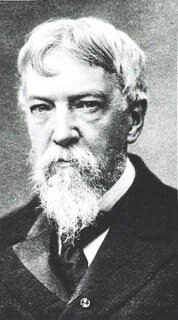
About the time Howard Unruh took his Luger for a walk in Camden my mother took me to enroll in kindergarten at S. Weir Mitchell public school, which, per Wikipedia, is historic. S. Weir Mitchell was a physician, scientist, novelist, and poet. He lived before there was movies, TV, or Twitter so he had a lot of time to kill. He discovered Mitchell’s Disease and it would have been damned odd if someone else had. He prescribed a high fat diet and lots of rest which helps explain his popularity. Without him we might not have all those cartoons with shrinks and couches since Freud got the couch idea from Mitchell. He coined the term “phantom limb” and is the father of medical neurology. No one knows who the mother was. Virginia Woolf was subjected to his treatment, but she managed to write a few novels anyway. He’s buried in Woodland Cemetery should you wish to pay your respects. Here he is now looking very 19th Century ->
Mom and I stood in one of the many lines in one of the bays behind the school. She held my hand while I surveyed the scene. A lot of kids were crying and their mothers were trying to comfort them.

I thought it was silly to be afraid. After all, my mother wasn’t worried and if she thought everything was okay, that was good enough for me. I looked up at her, she looked down at me. I said, “You can go home now, I don’t need you anymore”. She started to cry.
It didn’t turn out well though. It was boring and sappy and you had to drink warm milk and take a nap. While the old lady who was in charge plunked away on her piano and the other kids laid on the floor sucking their thumbs, I’d sit in the window and look right up Allison Street at my house.

I knew what was in that house. I knew all about it, my room upstairs with my maps of darkest Africa and my books with pictures of frogs and salamanders, the basement with Pop’s workbench and short-wave radio that would shock you if you weren’t careful how you touched it. My dartboard was propped on a kitchen chair in that basement. I could roller skate in that basement. I had little bowling pins and a softball to knock them down in that basement. What wasn’t in that basement was me.

I’m sure I voiced my displeasure, probably repeatedly. And I’m sure Pop was less than keen on my being in public school in the first place. On the other hand, Mom had at home a five year old and a newborn so placing me somewhere for some hours a day was a question of sanity. But what to do? There being in those days no such thing as day care, that left school, and if Mitchell kindergarten wasn’t going to cut the mustard, that left only Most Blessed Sacrament, MBS, that had only grades 1 through 8. I can just hear Mom now, pleading her case:
“Take him from this house part of the day; take him to kindergarten if he’ll stand it, or take him to first grade if they’ll have him; take him to whichever school will suffice, be it public or parochial, but take him while I still have all my marbles.” Mom shared with Winston Churchill a weakness for the rhetorical device conduplicatio.
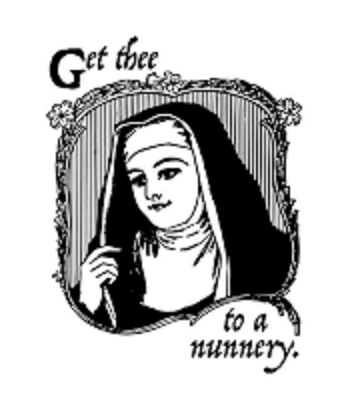
So Pop took me to the nunnery. Most lamentable day, most woeful day, that ever I did behold! Oh day, oh day, Oh hateful day! On what should have been a nice, sunny day there was I bedecked in suit and tie. Pop held my hand as we made our fateful way along Kingsessing Avenue toward 56th Street. I kicked stones until he told me to stop, that I would scuff my shoes, which was something adults cared about. We trudged up the steps of the convent and he rang the bell while I scratched at the tiny sparkles in the granite wall. A nun opened the door and smiled at Pop. So odd how nuns are always so civil and well-behaved around adults and raging viragos around kids. While they talked I examined the crucifix that hung from her neck, focusing on Our Lord’s sharply jutting knees. A delicate breeze billowed the nun’s black habit and Jesus with it. ‘Twas an omen, I see that now it’s too late. She asked us in and when Pop told her he wanted to put me in first grade, but she said five was too young, you had to be six. Pop then explained why that didn’t matter. He told her I could already read. She went away and came back with a book, sat me on a bench by the front door and told me to read the book while she and Pop talked. So I read and they watched. Afterward, the nun asked me about the book, what it was about, what happened in it, that sort of thing.
When I had learned to read is uncertain. My mother claims I was reading “Catholic Digest” when I was 3. My mother was also an exceptionally dubious witness. When I was a coder at the Institute for Social Research (ISR) in Ann Arbor, Michigan, she told people I was a decoder for the IRS – in Panama! She also told people I was a combat vet in Nam but I had never set foot in the place. In any event, “Catholic Digest”? The Sunday funnies maybe. “The Little Engine that Could” maybe. This much was clear, though: I could read by age 5 and it seems no one taught me. It just happened. So it never occurred to me that someone might teach you how to read. I thought it was just another thing you picked up along the way, like walking or talking. Which is one reason I found school so confusing.
There was one time when a boy named William (I still remember his last name which I shall not divulge, it being on a need to know basis) was reading to the nun and it was not going well. Inexplicably, William persisted in misreading the book which did not improve the nun’s baseline surly demeanor. I found three things about this procedure puzzling:
- Why did the nun want us to read this book to her at all, much less over and over? She had clearly read it herself, indeed, had it committed to memory since, never consulting the text, she would immediately threw a tantrum whenever a boy strayed from it.
- Why did some of the boys, like William, not just read the stupid words and be done with it? Why piss the nun off like this? No good would come of it, surely they knew that. In fact, it was clear neither William nor any other boy derived any amusement from this policy, so why do it?
- Why were we reading this dumb book anyway? Nothing ever happened. Some kid and his sister watched their dog run. Whoopee.
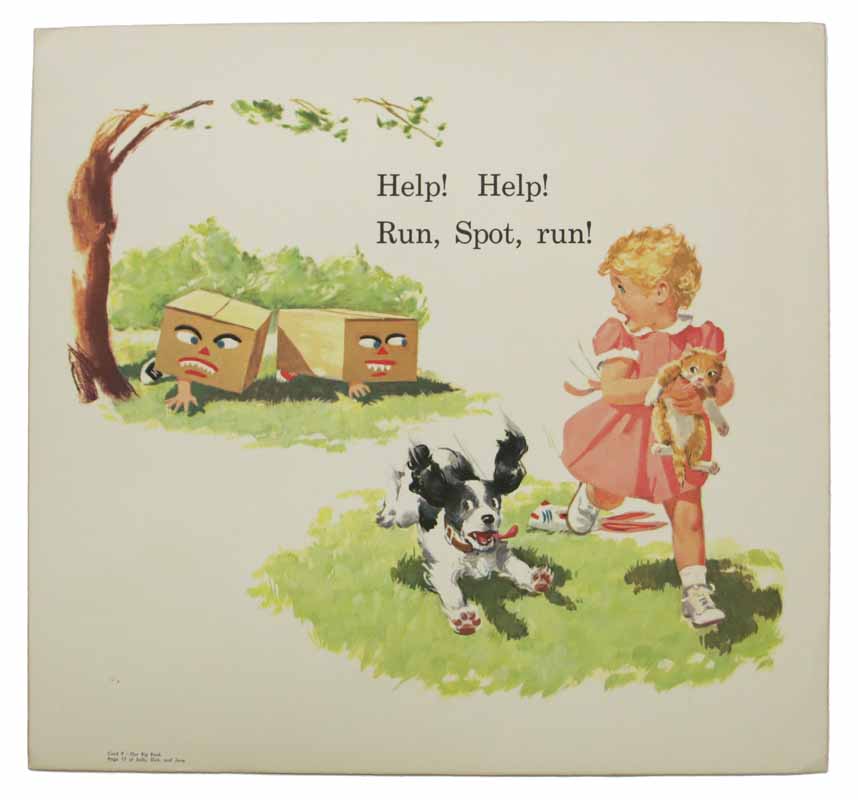
Turns out, a few years later, the nation’s school systems did actually decide kids might learn better if the material was more interesting. In 1957 Houghton Mifflin asked a former advertising illustrator named Theodore Geisel if he could write a more interesting primer with a 220 word vocabulary, and we got this ->

Though I’d learned how to read I had not evidently learned how to write. And the nuns were very keen on penmanship, which classes went smoothly enough except for the cursive ‘m’. I didn’t like squeezing all those nice little humps together, so my ‘m’ looked like a sine wave. Far more attractive.

One evening Pop did his level best to correct this. It’s the only memory I have of either parent ever helping me with homework. He patiently showed me a proper ‘m’, then had me try one. No, no, he said. Not like that, like this. And he did a second one. And a third, fourth and fifth. With every m he got more exasperated. What the hell was wrong with this kid anyway? Push the goddamn humps together! How hard can it be? But it was a question of aesthetics. I liked my m’s free flowing, waving like the offshore surf, not all miserly scrinched together. After a while he decided to let Sister Terrorsita handle it and he stomped off. It was her job, after all, and, knowing nuns as he did after himself doing eight years at MBS, he had every confidence she’d straighten me out. And, sure enough, next day in penmanship class I mercilessly smashed those poor little humps all chockablock. It was one thing to irk Pop, quite another to irk a black robed harridan armed with an 18 inch oak ruler.
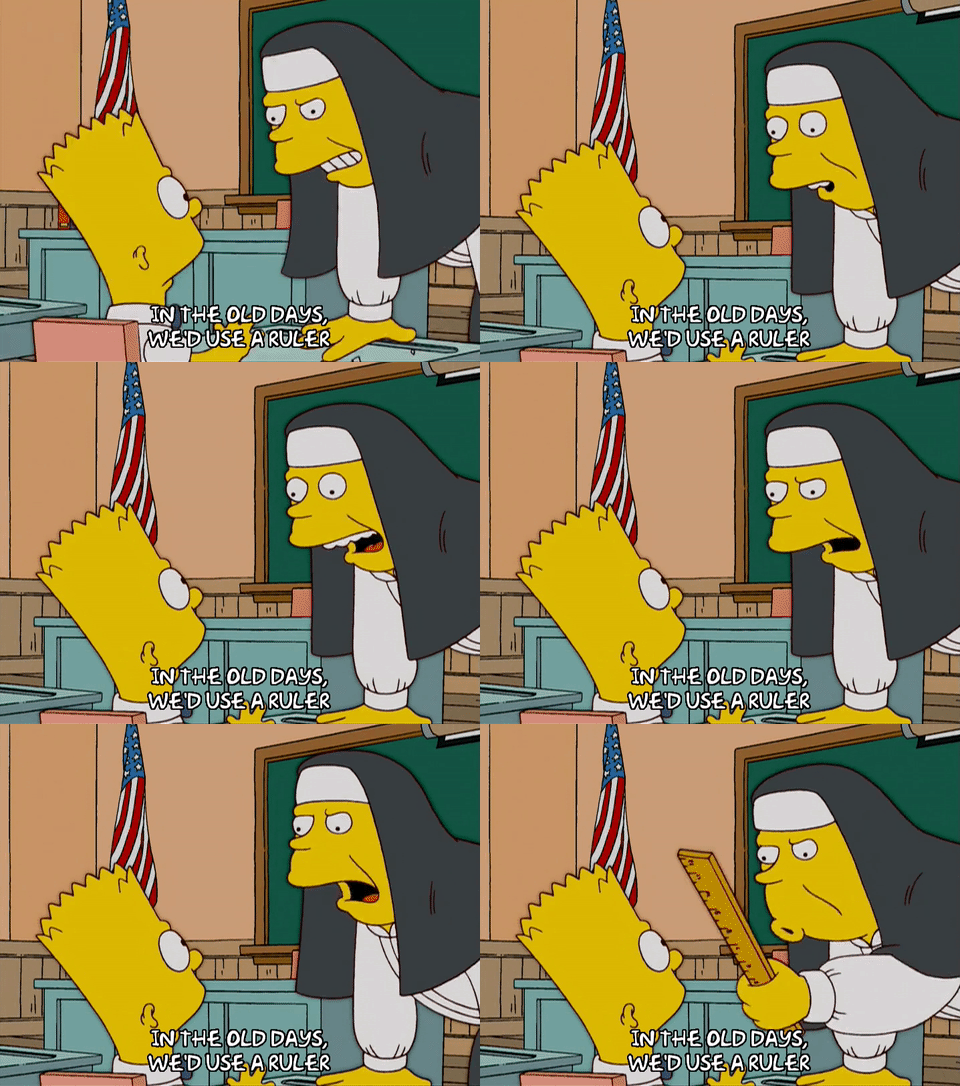
How I longed for the good old days at Mitchell with the harmless old lady and her piano and the naps and the warm milk. That had been merely boring. Now life was hellish. The nuns were like the Nazis in the movies. I wouldn’t have been surprised if one put out a cigarette in some kid’s eye. In some ways, they were worse than the Nazis who never made the prisoners in Stalag 17 sit for an hour perfectly still with their hands folded. That would have broken William Holden. And Mom informed me I was on no account to complain about being hit by Sister since if I didn’t deserve it this time I deserved it some other time when I’d gotten away with something. In fact, I should consider myself lucky Mom didn’t hit me as well, for good measure.
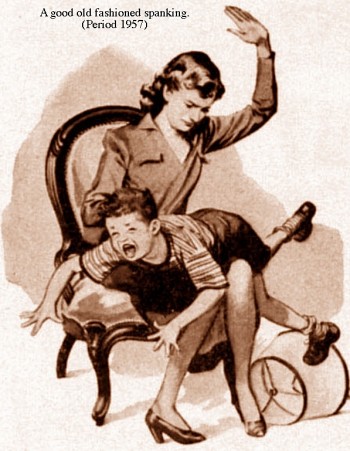
Actually, Mom never spanked me. That would have been too kinky. Instead, she’d bean me with a frying pan which isn’t kinky at all. Years later, at Marine Corps boot camp a DI would hit me and I’d think, “Is that all you got? You shoulda seen Sister Marciano.” Another MBS thing that prepared me for Parris Island was close order drill. The nuns would march us everywhere in columns of two, signaling when to stop, start or turn with their clickers. Here’s one now ->
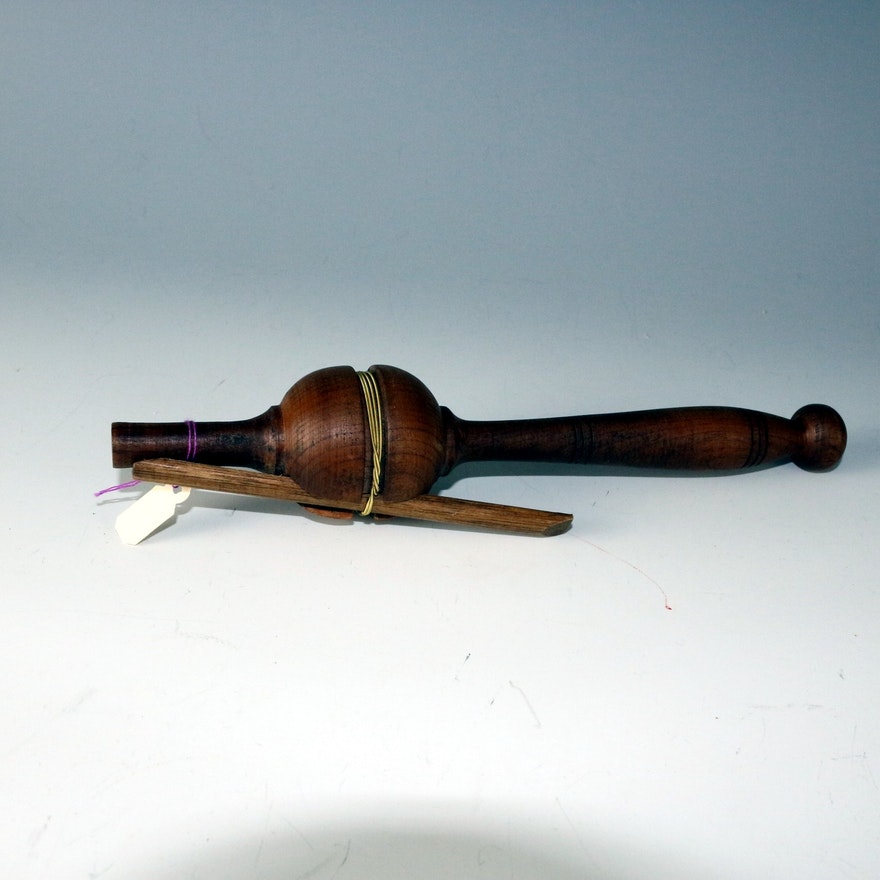
They would hold it like a German hand grenade and thumb that bit that was held on by a rubber band, then let it go and it would make a clicking sound. One click, you did this, two clicks you did that. It also made a handy cosh. A couple raps on the noggin was good for what ailed you. I did 8 years, no parole, no time off for good behavior. At least I wasn’t mollycoddled like kids today.
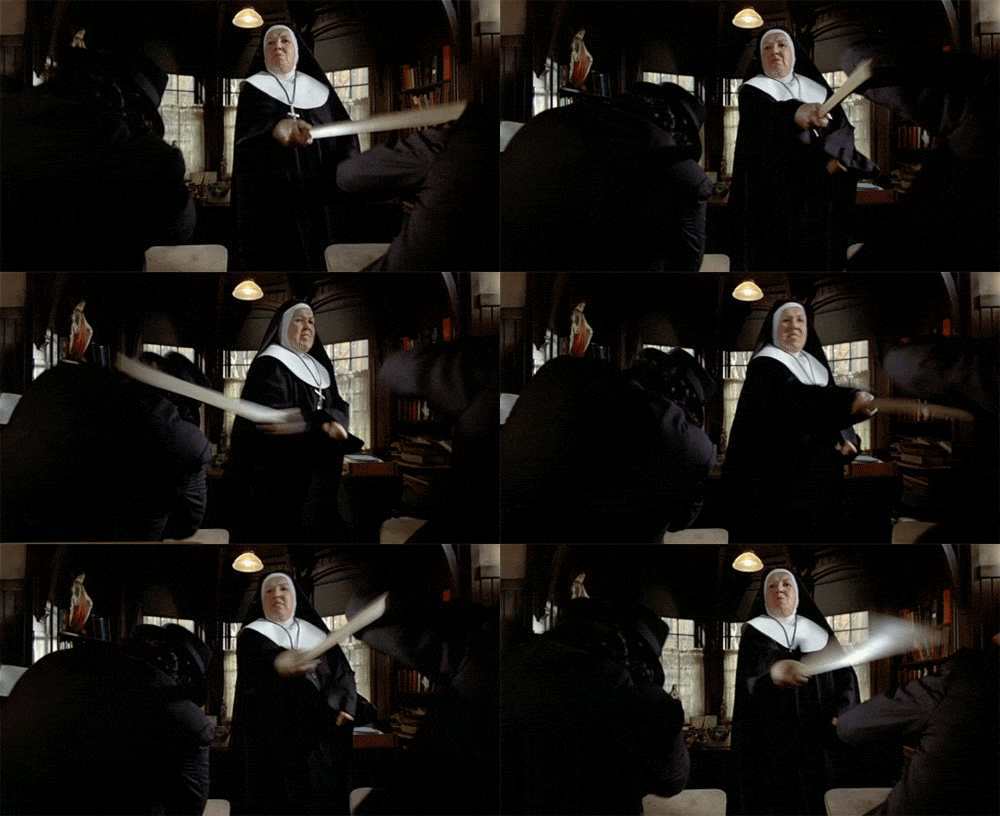
And by the way, for those readers who may be contemplating a nun fetish, this is NOT what nuns look like ->

Not a nun 
So not a nun 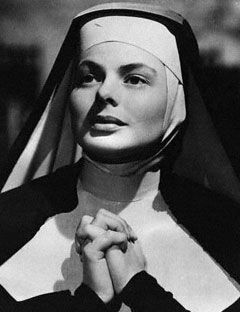
Are you kidding?
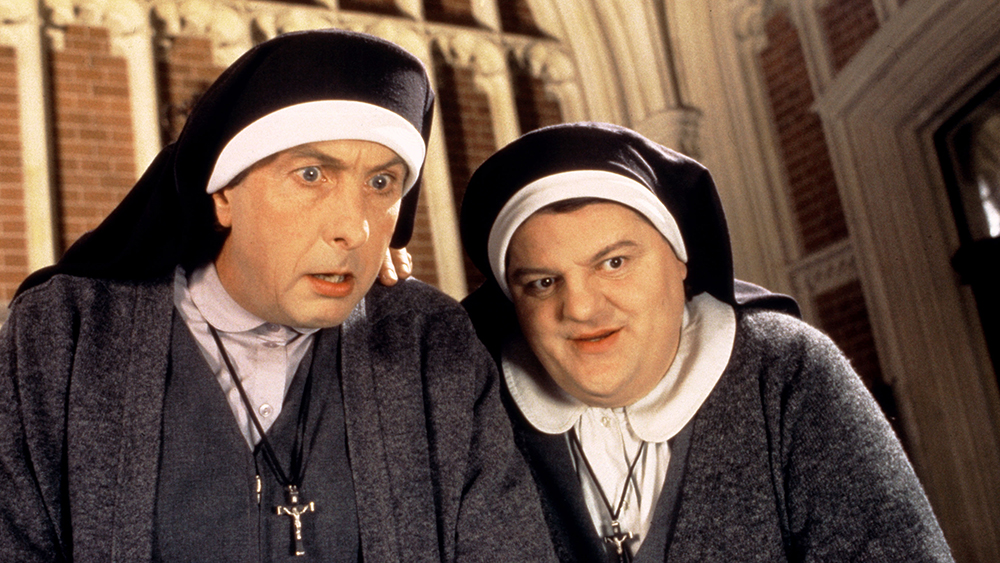
More like this ->
Finally, since you’ve made it this far, here’s a spanking GIF I found amusing but was unable to work into the piece ->
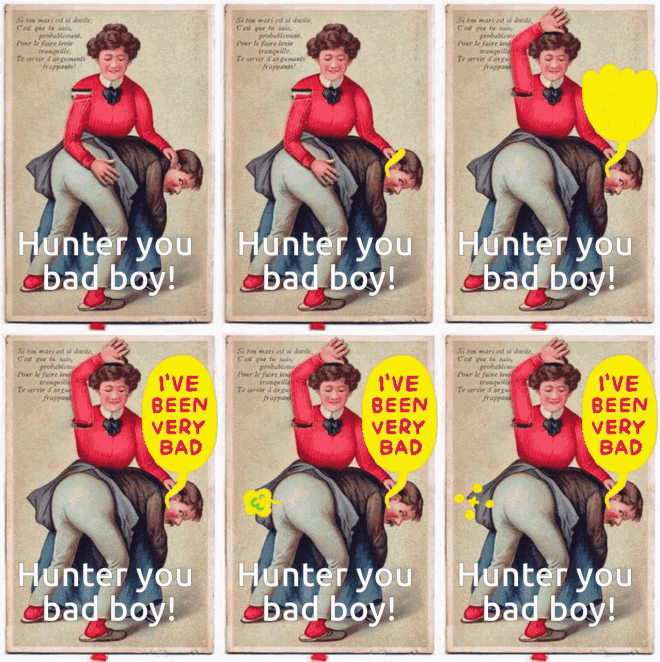
The French says “If your husband is docile, you probably know, in order to slow him down, use striking arguments”. Damn if I know what that means. You can get a print of it from the Museum of Fine Arts in Boston. Seriously.
