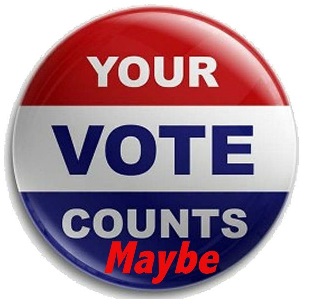
In 2000, George W. Bush lost the popular vote but won the electoral. W then ignored warnings about Osama Bin Laden and we got 9/11, which then got us the utterly uncalled for Iraq War. Far from done, he finished up with the Great Recession. In 2016, Donald Trump lost the popular vote but won the electoral and we got, well, Trump.
So what’s up with this Electoral dohickey? Wasn’t it supposed to prevent the election of demagogues? Instead of lengthy theoretical discussion of its original intent and present worth, however, let’s cut to the chase. What it actually does is make the value of your vote inversely proportional to the population of your state. In 2016, California cast nearly 14 million votes for the 4 main presidential candidates, Wyoming fewer than 250,000. In California, therefore, it took nearly 255,000 votes to produce 1 electoral vote, in Wyoming it took a tad over 82,000. Which works out to 1 Wyoming vote being worth about 3 California votes.
What’s more, most states are winner take all which means your individual vote is completely torched unless you voted for the winner. Otherwise you might have stayed home which, of course, many do. In 2016 almost 49% of Florida voters had their votes cancelled because they voted for Hillary Clinton.
But at least in presidential elections you do get to cast a vote. In most elections that affect you you don’t.
In 2014, a mere 806,878 Kentuckians, something like 23% of that state’s population that were or could have been eligible voters, reelected Mitch McConnell. As Senate Majority Leader, McConnell gets to decide when and if a proposition is open to discussion. This one man can, for any reason whatsoever, bury stillborn the brainchild of any other Senator or group of Senators. This one man can, for any reason whatsoever, deny the other 49 Senators the opportunity to perform the duty they owe their constituents. This one man can, for any reason whatsoever, spay the entire Senate, which means he can also block anything from the House of Representatives. In other words, this one man can deny the entire country, minus that 806,878 that reelected him, their due representation.
The Russians have meddled in our electoral process, are still meddling and will continue to meddle. Many Senators, almost entirely Democrats, oddly enough, want to prevent same, indeed owe it to the people they represent to do so, and this one man now peremptorily denies them, and us, the opportunity even to discuss it much less vote on it. How can this be right? How can one man, elected by .2% of the nation’s population, have this much power over the remaining 329 million who didn’t even get to vote for or against him?
And this is true of every national seat, be it Senate or House. Each Congress person is elected by a smallish percentage of the national population and then goes on to affect the entire nation. When Rand Paul prevents the Senate from passing the 9/11 First Responders bill, 33% of the people of Kentucky, in effect, are obstructing the will of the vast majority of the nation. Shouldn’t we who are affected have some say in this matter?
Imagine if, instead of 1 Senator 1 vote, it was 1 Senator voting for those he/she represents. When Mitch McConnell cast a vote it would count as 806,878 votes but when Kirsten Gillibrand, say, cast a vote it would count as 4,056,931 votes. In other words, each Senator would be saying, “the X number of people who put me here say yea or nay”. Then, instead of the Majority Leader deciding unilaterally whether to put a bill on the floor, each bill could be presented or tabled by a simple majority vote. Such a system would have the side effect of increasing turnout since voters would want their Senator to have as much clout as possible. Of course, this completely defeats the intent of the Founders when they created the Senate, but, in view of its modern shenanigans, was that really such a great idea anyway?
Nor are the aforementioned the only ways your vote is adversely affected. Each state gets to set its own voting procedures, procedures that affect all the rest of us. Is it fair that Georgia, say, can completely ignore secure voting procedures and then send its representatives to the national Congress? Is it fair that North Carolina, say, can gerrymander its districts to ensure one party’s dominance and then send its representatives to the national Congress? Is it fair that Ohio, say, can purge a few hundred thousand records from its voting rolls, again to ensure one party’s dominance and then send its representatives to the national Congress? Is it fair that Florida, say, can block early voting to reduce the youth turnout and then send its representatives to the national Congress? Is it fair that all these states, and more, employ all these measures, and more, in order to suppress turnout and then send their representatives to the national Congress? It isn’t fair even to their own voters much less the rest of us. Clearly, federal guidelines are needed on voting equipment, voting days and hours, early voting, absentee voting, automatic registration, the management of voter rolls, especially their purging, etc. And, oh yeah, gerrymandering.
In this country one man one vote has never been the case. Maybe that needs to change. Finally.

Jonathan Alter was on Lawrence O’Donnell the other night, explaining about the National Popular Vote Compact, which 12 or 13 states have already agreed to. Basically, it allows the state electors to vote for the winner of the national popular vote. He says that’s one way around a constitutional amendment. Also, I’ve read that electors can (and have) vote for a different candidate, and only be subject to a small fine. Maybe if enough shit continues to come out about Trump (lawsuits, crony appointments, etc) by the time the electors meet, they COULD do it?
Interesting. Hadn’t heard of the compact, will look into it. As for faithless electors, there have been 2 this century, one by accident, one a no vote protest. If it were today and a sufficient number of electors switched to HRC there would be hell to pay. GOP would go nuts and chaos would ensue. If, however, Trump is found guilty of fraud or whatever, with sufficient cause electors might switch but they’d probably just switch to Pence. Doesn’t have to be HRC. I’m sure the GOP would have to give them the go-ahead. So, ask yourself, Trump or Pence? Not an easy choice. Trump may well be the lesser evil. And, now that I think of it, using that Compact to switch the election would also raise hell.
I’d actually prefer Trump to Pence, but my impression (without actually researching it) is that just by virtue of the name “National Popular Vote” compact, Pence wouldn’t be an option? It would be the winner of the popular vote. Either way, there would be hell to pay, of course. And then Obama would declare martial law and stay in office, just like the Alt-Right has predicted, lol!
Do you know who the electors are anyway? And how they get to be one?
Sorry, wasn’t clear. The Trump v. Pence part of my reply was in regard to faithless electors, not NPV. The problem, today, with NPV, is you need a lot more states to ratify it. The 11 already ratified are all blue so most of those needed states would be red and why would a red state ratify before Trump takes office? The only possibles would be red states controlled by blue state governments. Just ain’t enough of those, if any. To get Clinton to 270 you’d need something like 3 of Florida, Michigan, Wisconsin and Pennsylvania and I don’t think any of them are blue enough to ram ratification through.